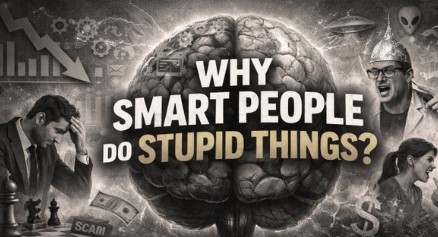
Why Intelligent People
Do Stupid Things
Uncover the fascinating psychology behind why the brightest minds make the poorest decisions—and learn how to protect yourself from these cognitive traps.
Quick Summary for Social Media
🧠 Smart ≠ Wise: High IQ doesn’t protect against bad decisions. Even geniuses fall for cognitive biases, emotional reasoning, and overconfidence. The fix? Intellectual humility + diverse perspectives + slow thinking. Your brain has bugs—learn to patch them! #Psychology #SelfImprovement
Introduction
Have you ever watched someone brilliant make a decision so baffling that you wondered if they’d temporarily lost their mind? You’re not alone—and there’s fascinating science behind it.
Intelligence and wisdom are not the same thing. This fundamental truth explains one of life’s greatest paradoxes: why highly intelligent people—PhDs, CEOs, scientists, and experts—often make decisions that seem utterly foolish to outside observers.
In 2026, as we navigate an increasingly complex world filled with AI, information overload, and rapid change, understanding this phenomenon has never been more critical. The smartest people in the room aren’t always the wisest decision-makers, and recognizing this can transform how you approach your own choices.
Key Insight
Research from Nobel laureate Daniel Kahneman shows that cognitive ability (IQ) and rational thinking are largely independent. A high IQ doesn’t protect you from cognitive biases—it might even make you better at rationalizing bad decisions.
This comprehensive guide will explore the psychological mechanisms that cause intelligent people to stumble, provide real-world examples, and most importantly, give you practical tools to avoid these same pitfalls in your own life.
The Science Behind It
The human brain operates on two distinct systems, as described by psychologist Daniel Kahneman in his groundbreaking work:
System 1: Fast Thinking
- Automatic and unconscious
- Relies on intuition and heuristics
- Prone to cognitive biases
- Emotional and reactive
System 2: Slow Thinking
- Deliberate and conscious
- Analytical and logical
- Requires mental effort
- Better for complex decisions
Here’s the critical insight: Intelligence primarily enhances System 2 thinking—the slow, analytical part. But most of our daily decisions are made by System 1, which operates on autopilot and is equally vulnerable to biases in everyone, regardless of IQ.
The Intelligence Trap
Intelligent people often trust their intuition more because it’s frequently right in their area of expertise. This confidence can backfire spectacularly when applied to domains where their expertise doesn’t transfer.
Furthermore, neuroscience research reveals that emotional centers of the brain (like the amygdala) can hijack decision-making before the rational prefrontal cortex even gets involved. This “amygdala hijack” affects everyone equally—your IQ provides no protection.
7 Key Reasons Why Smart People Make Dumb Decisions
Overconfidence Bias
Intelligent people often overestimate their abilities outside their area of expertise. Success in one domain creates a false sense of competence in others. A brilliant surgeon might make terrible investment decisions, assuming their general intelligence transfers to finance.
Real Example: Isaac Newton, one of history’s greatest minds, lost the equivalent of $4 million in today’s money during the South Sea Bubble of 1720, famously saying, “I can calculate the movement of stars, but not the madness of men.”
Emotional Reasoning
Despite their analytical abilities, intelligent people are not immune to emotional decision-making. In fact, they often use their intellect to construct elaborate rationalizations for emotionally-driven choices. They’re essentially using their brainpower to justify what their heart already decided.
Warning Sign: If you find yourself creating complex justifications for a decision you’ve already made, you might be engaging in emotional reasoning dressed up as logic.
Analysis Paralysis
The ability to see multiple perspectives and possibilities can become a curse. Intelligent people may overthink decisions to the point where they either make no decision at all, or delay so long that opportunities pass them by. Sometimes, a good decision made quickly beats a perfect decision made too late.
The 70% Rule: If you have 70% of the information you need, make the decision. Waiting for 100% certainty usually means waiting too long.
Blind Spots in Expertise
Deep expertise in one area can create dangerous blind spots. Specialists may dismiss information from other fields, or apply specialized thinking to general problems inappropriately. The hammer sees every problem as a nail.
The Curse of Knowledge: Once you know something, you can’t remember what it was like not to know it. This makes experts terrible at communicating with non-experts or understanding their perspective.
Ego and Identity Protection
When intelligence becomes part of someone’s identity, admitting mistakes becomes personally threatening. Smart people may double down on bad decisions rather than admit error, because being wrong feels like an attack on their core self-image.
The Sunk Cost Fallacy: “I’ve invested so much in this decision, I can’t quit now.” Intelligence doesn’t protect against this trap—and may even make it worse because intelligent people hate admitting they were wrong.
Social Isolation & Echo Chambers
Intelligent people may surround themselves with similar thinkers, creating echo chambers that reinforce existing beliefs. They might also dismiss input from “less intelligent” people, missing valuable perspectives and practical wisdom.
Wisdom from Diversity: The best decisions often come from cognitively diverse teams. A “less intelligent” person with different life experiences may see things that experts miss entirely.
Stress and Decision Fatigue
Under stress or when mentally exhausted, even the brightest minds default to System 1 thinking. High-achieving individuals often push themselves to exhaustion, ironically making their worst decisions when the stakes are highest.
The Power of Sleep: Studies show that sleep deprivation impairs judgment as much as alcohol intoxication. Yet many “smart” professionals pride themselves on sleeping less. This is objectively stupid.
Common Cognitive Biases That Trap Smart People
Understanding these biases is the first step to overcoming them. Here are the most common cognitive traps that affect intelligent people:
Confirmation Bias
Seeking information that confirms existing beliefs while ignoring contradicting evidence.
Dunning-Kruger Effect
Overestimating competence in unfamiliar areas while experts often underestimate themselves.
Anchoring Bias
Over-relying on the first piece of information encountered when making decisions.
Availability Heuristic
Overweighting easily recalled information when assessing probability or importance.
Hindsight Bias
Believing, after an outcome, that you “knew it all along,” distorting learning from experience.
Self-Serving Bias
Attributing successes to skill and failures to bad luck or external factors.
Real-World Examples
Long-Term Capital Management (1998)
This hedge fund was founded by Nobel Prize-winning economists and PhD mathematicians. Their models were brilliant—until they weren’t. The fund collapsed spectacularly, losing $4.6 billion and nearly crashing global markets. Their intelligence created overconfidence in models that couldn’t account for human panic.
Enron’s Executive Team
Staffed with Harvard MBAs and celebrated as “the smartest guys in the room,” Enron’s leadership created an elaborate fraud that destroyed the company. Their intelligence was used to construct increasingly complex schemes to hide debt, demonstrating how smarts without ethics leads to disaster.
Steve Jobs’ Medical Decisions
The visionary Apple founder initially chose alternative treatments over proven medical interventions for his cancer. Despite having access to the best doctors and information, his belief in his own judgment delayed potentially life-saving surgery by nine months. Jobs later expressed regret about this decision.
Kodak’s Digital Camera Denial
Kodak invented the digital camera in 1975 but buried it to protect film sales. Their brilliant engineers saw the future but leadership’s attachment to existing success prevented adaptation. A company with genius-level innovation died from management-level blindness.
Watch: Deep Dive Video
Watch this insightful video for more examples and psychological insights into smart decision-making failures.
Decision Quality Calculator
Assess your decision-making vulnerability
Answer honestly to discover your susceptibility to cognitive biases. This simple assessment helps you understand where to focus your decision-making improvements.
Educational Tips & Insights
Read Widely
Expose yourself to ideas outside your expertise. Read philosophy, history, psychology, and fiction. Cross-disciplinary knowledge creates cognitive flexibility that protects against narrow thinking.
Cultivate Diverse Networks
Build relationships with people from different backgrounds, ages, and industries. Their perspectives will challenge your assumptions and reveal blind spots you didn’t know you had.
Practice Pre-Mortems
Before major decisions, imagine it’s one year later and the decision failed spectacularly. Write down all the reasons why. This technique, created by psychologist Gary Klein, surfaces hidden risks.
Implement Waiting Periods
Create personal rules: no major decision without 24-hour delay. No purchase over $500 without sleeping on it. No job change without talking to three trusted advisors. Systems beat willpower.
Keep a Decision Journal
Document your reasoning before decisions, then review outcomes. This creates a personal database of your decision patterns and helps identify recurring biases you can work on.
Set Up Decision Triggers
Create automatic alerts: “If I’m about to invest more than 10% of savings…” or “If I’m making this decision after 10pm…” These triggers pause System 1 and activate System 2.
Key Takeaways
- Intelligence ≠ Wisdom: High IQ measures specific cognitive abilities, not decision-making quality
- Biases Are Universal: Everyone has cognitive biases; smart people are just better at rationalizing them
- Systems Beat Willpower: Create decision-making structures that compensate for human limitations
- Humility Is Power: The most effective thinkers know what they don’t know
Prevention Strategies
Now that you understand why intelligent people make poor decisions, here’s how to protect yourself:
Practice Intellectual Humility
Regularly remind yourself what you don’t know. Ask yourself: “What would I need to see to change my mind?” If you can’t answer, you’re not thinking—you’re rationalizing.
Create Structured Decision Processes
Use checklists, frameworks, and forced delays for important choices. The best pilots use checklists despite their expertise—you should too.
Seek Devil’s Advocates
Before major decisions, assign someone to argue against your preferred choice. Better yet, argue against it yourself. Can you steelman the opposition?
Manage Your Mental State
Never make important decisions when tired, hungry, stressed, or emotional. If you can’t delay the decision, at least acknowledge your impaired state.
Embrace Being Wrong
Reframe mistakes as learning opportunities. The goal isn’t to never be wrong—it’s to be wrong less often over time. That requires acknowledging and analyzing failures.
Frequently Asked Questions
Explore More on Asthetic Life
Continue your journey of self-improvement with these related articles:
Share this:

More for your journey.

Aesthetic Digital Planner | Daily, Weekly & Monthly Planner
Aesthetic Digital Planner | Daily, Weekly & Monthly Planner Stay beautifully organized with a cute kawaii digital planner that makes productivity feel…
Read story
How to Prepare for 2026: A Practical Timeline for Career, Money, AI, Health, and Personal Growth
2026 is closer than it feels. This practical guide helps you prepare your career, finances, health, skills, and mindset with a simple timeline and an interactive…
Read story
How Many Generals Did Trump Fire? The Complete Timeline
How Many Generals Did Trump Fire? Full Timeline & 2026 Analysis March 26, 2026 · 12 min read · Military & Politics How Many Generals Did…
Read story