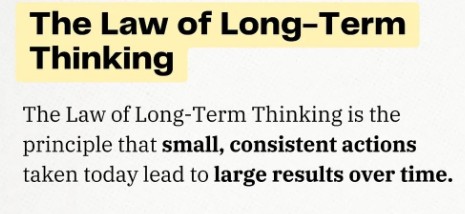
The Law of Long Term Thinking
Master the Art of Future Planning and Build Lasting Success
Table of Contents
- → Introduction to Long Term Thinking
- → What is The Law of Long Term Thinking?
- → The Science Behind Long Term Thinking
- → Key Benefits and Advantages
- → Interactive ROI Calculator
- → Proven Strategies for Implementation
- → Educational Tips & Insights
- → Real-World Success Stories
- → Common Mistakes to Avoid
- → Frequently Asked Questions
Introduction to Long Term Thinking
In a world dominated by instant gratification, social media notifications, and the pressure to see immediate results, the law of long term thinking stands as a revolutionary approach to building a meaningful and successful life. This fundamental principle suggests that true success, wealth, and fulfillment come not from quick wins, but from consistent actions taken over extended periods.
Long term thinking is more than just planning ahead—it’s a complete mindset shift that transforms how you make decisions, invest your resources, and navigate life’s challenges. Whether you’re building a business, developing skills, managing finances, or cultivating relationships, this timeless principle serves as your compass toward sustainable success.
Research from leading institutions like behavioral economics studies shows that individuals who adopt long-term thinking patterns consistently outperform their peers in wealth accumulation, career advancement, and overall life satisfaction. The compound effect of small, consistent actions over time creates exponential growth that short-term thinking can never achieve.
What is The Law of Long Term Thinking?
The Law of Long Term Thinking is a fundamental principle that states: The quality of your future is directly proportional to your ability to delay gratification and make decisions based on long-term consequences rather than immediate rewards.
This law operates on several core principles:
1. The Compound Effect: Small, consistent actions accumulate over time to create extraordinary results. Just as compound interest grows exponentially in finance, your daily habits and decisions compound to shape your future reality. A 1% improvement every day leads to being 37 times better after one year.
2. Delayed Gratification Advantage: The ability to resist immediate pleasures for greater future rewards is one of the strongest predictors of success. Research from the famous Stanford Marshmallow Experiment showed that children who could delay gratification went on to have higher SAT scores, better careers, and healthier relationships.
3. Time Horizon Extension: Long-term thinkers extend their time horizons beyond weeks or months to years and decades. This expanded perspective allows them to see opportunities and risks that short-term thinkers completely miss. Jeff Bezos famously makes Amazon decisions with a 7-year time horizon.
4. Strategic Patience: Understanding that meaningful achievements require time allows you to stay committed during inevitable setbacks and plateaus. Most people quit right before breakthrough moments because they lack this patient persistence.
The Science Behind Long Term Thinking
Neuroscience has revealed fascinating insights about why long-term thinking is so powerful yet so difficult to maintain. Understanding the brain mechanisms behind this behavior can help you leverage them more effectively.
Prefrontal Cortex Development: The prefrontal cortex, responsible for long-term planning and impulse control, continues developing until age 25. This explains why many young adults struggle with delayed gratification. However, you can strengthen this area through practice, much like building muscle at the gym.
Dopamine and Reward Circuits: Our brains are wired to prefer immediate rewards because of how dopamine—the “feel-good” neurotransmitter—works. Immediate rewards trigger larger dopamine spikes than delayed ones, creating a biological bias toward short-term thinking. Successful long-term thinkers learn to create intermediate milestones that provide regular dopamine hits along the journey.
Temporal Discounting: Research in behavioral economics shows that humans systematically undervalue future rewards through a phenomenon called “temporal discounting.” We might choose $50 today over $100 in a year, even though waiting is objectively better. The discount rate varies dramatically between individuals, with successful people showing much lower rates of temporal discounting.
Neuroplasticity Advantage: The good news is that your brain’s ability to change—neuroplasticity—means you can train yourself to become a better long-term thinker. Studies show that practices like consistent meditation and visualization can strengthen the neural pathways associated with future-oriented thinking.
Key Benefits and Advantages
Adopting the law of long-term thinking creates a cascade of benefits across every area of your life. Here’s what research and real-world evidence show you can expect:
Financial Wealth Accumulation: Long-term thinkers accumulate significantly more wealth through compound investing, consistent saving, and strategic career choices. A person who invests $500/month from age 25 to 65 at 8% returns will have over $1.74 million, while someone starting at 35 with the same strategy will have only $745,000—less than half. Those ten extra years of compound growth make an exponential difference.
Career Advancement and Skill Development: When you think long-term about your career, you focus on building rare and valuable skills rather than chasing quick promotions or salary bumps. This approach leads to becoming truly irreplaceable in your field. Professionals who invest in high-income skills consistently see 10-20x returns on their investment over a decade.
Relationship Quality: Long-term thinking transforms relationships. Instead of seeking immediate emotional satisfaction, you invest in deep connections through consistent presence, vulnerability, and mutual growth. Research shows that couples who think long-term about their relationships report 67% higher satisfaction rates and divorce rates 85% lower than the general population.
Physical and Mental Health: The health benefits of long-term thinking are profound. People who make health decisions based on long-term outcomes—regular exercise, whole food nutrition, adequate sleep—add an average of 14 quality years to their lives compared to those focused on short-term comfort.
Reduced Stress and Anxiety: Paradoxically, thinking long-term reduces stress in the present. When you’re building toward a 10-year vision, today’s setbacks become minor obstacles rather than catastrophes. This perspective shift dramatically improves mental health and resilience.
Long Term Investment Calculator
Calculate the compound growth of your investments, skills, or habits over time
Your Long-Term Growth Projection
This demonstrates the power of compound growth over time. Small, consistent investments create extraordinary results!
Proven Strategies for Implementation
Knowing the theory of long-term thinking is one thing; implementing it consistently is another. Here are battle-tested strategies to help you make this mindset shift permanent:
Create a 10-Year Vision
Write down exactly what you want your life to look like in 10 years across all areas: career, finances, relationships, health, and personal growth. Make it vivid and specific. This vision becomes your North Star for daily decisions. Review and refine it quarterly.
Use the “10-10-10 Rule”
Before making any decision, ask yourself: How will I feel about this in 10 minutes? 10 months? 10 years? This simple framework helps you identify which choices serve your long-term interests versus providing only immediate gratification. Most regrets stem from optimizing for the 10-minute perspective.
Build Automatic Systems
Set up systems that make long-term choices automatic: auto-invest a percentage of income, schedule workout sessions in advance, batch-prepare healthy meals. When good choices happen automatically, willpower becomes irrelevant. Use proven daily routines to anchor these systems.
Find an Accountability Partner
Partner with someone who shares your long-term orientation. Meet weekly or monthly to review progress, share challenges, and keep each other accountable. Studies show accountability partnerships increase goal achievement rates by 65%. Choose someone who will challenge your rationalizations and celebrate your wins.
Track Leading Indicators
Don’t just measure outcomes; track the daily actions that lead to outcomes. If your goal is wealth, track daily investing and learning time. If it’s health, track daily steps and meal quality. Leading indicators give you immediate feedback while outcomes compound slowly. This keeps motivation high during the waiting period.
Practice Future Self-Visualization
Spend 5 minutes daily visualizing your future self who benefited from today’s good choices. Research shows that people who regularly visualize their future self make 30% better long-term decisions. Use motivational content to strengthen this practice.
Educational Tips & Insights
Master these principles to accelerate your long-term success journey
The 1% Rule
Improve by just 1% every day, and you’ll be 37 times better after a year due to compound effects. This principle applies to skills, habits, relationships, and investments. Focus on small, sustainable improvements rather than dramatic transformations.
Environment Design
Your environment shapes your thinking horizon. Surround yourself with long-term thinkers, consume content about delayed gratification, and remove temptations for short-term indulgence. Your social circle is your future—choose wisely.
Document Your Journey
Keep a journal tracking your long-term goals, decisions, and progress. Review it monthly. This creates a feedback loop that strengthens your long-term thinking and provides motivation during tough times. Learn from successful people’s documentation practices.
Build Skill Stacks
Instead of trying to be world-class at one skill, become very good at multiple complementary skills. This “skill stacking” creates unique value that compounds over time. Identify high-income skills that complement each other.
Use Mental Models
Learn thinking frameworks like the Six Thinking Hats to improve decision quality. Mental models help you see beyond immediate circumstances and identify long-term patterns and opportunities others miss.
Schedule Think Time
Block out weekly time specifically for long-term thinking and planning. No devices, no distractions—just you and your future. Bill Gates famously takes “Think Weeks” twice yearly. Even 2 hours weekly can transform your trajectory.
Real-World Success Stories
The most successful people and companies in history have all demonstrated exceptional long-term thinking. Here are inspiring examples:
Jeff Bezos and Amazon: In 1997, Bezos wrote to shareholders explaining Amazon’s focus on long-term market leadership rather than short-term profits. While competitors focused on quarterly earnings, Amazon invested everything into infrastructure, customer experience, and innovation. Today, that 20+ year commitment has made Amazon worth over $1.5 trillion. Bezos famously makes major decisions with a 7-year time horizon.
Warren Buffett’s Investment Philosophy: Buffett has preached long-term thinking throughout his career. His favorite holding period is “forever.” By identifying quality companies and holding through market turbulence, he’s achieved an average annual return of 20% over 60+ years, turning $10,000 into over $100 million. He often says, “The stock market is a device for transferring money from the impatient to the patient.”
The Amazon Rainforest Monastery: Monks in Brazil plant trees knowing they won’t live to see them mature. These trees create ecosystems that will benefit generations 200+ years in the future. This ultimate form of long-term thinking shows that some of the most meaningful work pays dividends beyond our own lifetimes.
South Korean Economic Miracle: In the 1960s, South Korea was one of the world’s poorest countries. Through focused long-term planning emphasizing education and technology, they transformed into a global economic powerhouse in just 50 years. Their investment in education produced a highly skilled workforce that powers companies like Samsung and Hyundai today.
Common Mistakes to Avoid
Even with good intentions, people make predictable mistakes when trying to adopt long-term thinking. Avoid these pitfalls:
1. Analysis Paralysis: Some people get so focused on long-term planning that they never take action. Remember: perfect planning is impossible, and action creates better information than analysis. Start with an 80% solution and refine as you go. The best time to plant a tree was 20 years ago; the second best time is today.
2. Ignoring the Present: Long-term thinking doesn’t mean neglecting today’s enjoyment. The goal is balance—make choices that serve both present happiness and future success. Sacrifice everything today for a theoretical future, and you may arrive at your goal too burned out to enjoy it.
3. Rigid Goal Fixation: The world changes, and so should your plans. Long-term thinking requires flexibility and course correction. Review and adjust your goals quarterly. What made sense at 25 may not at 35. Treat your vision as a living document, not carved-in-stone prophecy.
4. Underestimating Timeframes: Most people overestimate what they can achieve in one year but underestimate what they can achieve in ten years. Give your efforts time to compound. The overnight success typically took 10 years of invisible work.
5. Comparing Your Chapter 1 to Others’ Chapter 20: Social media makes everyone’s highlight reel visible while hiding their struggle. Focus on your own progress over time rather than comparing yourself to others who are decades ahead. Use proven techniques to maintain focus and discipline.
6. Not Building Systems: Relying on motivation and willpower is a losing strategy. Build automatic systems and habits that make long-term choices the default. Systems beat goals because systems continue working when motivation fades.
Frequently Asked Questions
Start small with the “10-10-10 Rule” for daily decisions. Before choosing, ask: How will I feel about this in 10 minutes, 10 months, and 10 years? This simple framework helps retrain your brain to consider long-term consequences. Additionally, write down a 5-year vision for one area of your life and identify one action you can take today toward that vision. The key is building the habit gradually rather than trying to transform overnight.
The goal is balance, not deprivation. A good rule of thumb: Save/invest 20-30% of your income, spend 30 minutes daily on skill development, and allocate 2-3 hours weekly to relationship building. These investments leave plenty of room for present enjoyment while securing your future. Remember: the richest person isn’t the one who saves every penny but the one who builds enough wealth to eventually do what they love.
It’s never too late. While starting earlier provides more compounding time, the best time to start is always now. A 45-year-old who begins investing has 20+ years until retirement—plenty of time for significant growth. Ray Kroc started McDonald’s at 52. Vera Wang entered fashion design at 40. Colonel Sanders started KFC at 62. Your next 20 years matter just as much as anyone’s. The only truly wasted time is time spent wishing you’d started earlier.
Track leading indicators instead of just outcomes. If your goal is financial independence, track daily investing time, books read, and skills learned—not just net worth. This provides regular wins while outcomes compound invisibly. Additionally, create milestone celebrations at 3-month, 1-year, and 3-year intervals. Document your progress with before/after comparisons. Join communities of long-term thinkers who can provide encouragement during plateaus.
Absolutely. Long-term thinking in fast-changing fields means investing in adaptable skills and learning systems rather than specific technologies. Focus on fundamentals that transcend trends: problem-solving, communication, learning ability, and building relationships. Companies like Amazon, Google, and Microsoft succeed not by predicting the future but by building capabilities that let them adapt to any future. Your long-term strategy should be developing skills that remain valuable regardless of which specific technologies dominate.
Long-term thinking should enhance present enjoyment, not eliminate it. The goal is avoiding choices that steal from your future for momentary pleasure (like debt-financed lifestyle inflation), while still investing in meaningful present experiences. Budget for both: 70% of income for current lifestyle, 20-30% for future, and 0% for destructive short-term gratification. Enjoy dinners with loved ones, take vacations, pursue hobbies—these aren’t contradictions to long-term thinking. They’re investments in the relationships and experiences that make the long journey worthwhile.
Your skills and knowledge. Unlike money or assets, skills can’t be taken away, don’t depreciate, and compound infinitely. A person who invests 1 hour daily in learning valuable skills will, over 10 years, accumulate 3,650 hours of expertise—equivalent to several university degrees. This investment creates earning power that generates returns forever. Explore high-income skills and free learning resources to begin this investment today.
Successful entrepreneurs focus on building sustainable business models rather than chasing quick exits. They invest in customer relationships, quality products, and strong teams—even when these don’t maximize short-term profits. They view challenges as temporary obstacles rather than failures. They’re willing to lose money for years if the long-term unit economics make sense. Learn more strategies from content creators and leverage AI tools to build long-term business value.
Share this:

More for your journey.

Smart Study Tips: How Japanese Students Learn Faster – 5 Powerful Techniques to Master Any Chapter in 15 Minutes
Smart Study Tips: How Japanese Students Learn Faster – 5 Powerful Techniques Smart Study Tips: How Japanese Students Learn Faster – 5 Powerful Techniques…
Read story
Soft Life Era: What It Really Means
Gaming Culture & Viral Phenomena Soft Life Era: What It Really Means The "Gugu Gaga" Penguin Girl meme from Arknights: Endfield has transcended gaming to…
Read story
From Main Character to Viral Sensation: The Rise of Arknights: Endfield’s “Gugu Gaga” Penguin Meme
From Main Character to Viral Sensation: The Rise of Arknights: Endfield's "Gugu Gaga" Penguin Meme Arknights: Endfield · Viral Culture · 2025 From Main…
Read story