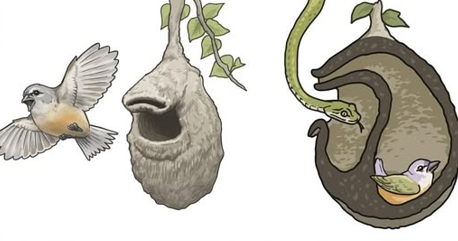
Amazing Penduline Nest — Nature’s Tiniest Architectural Masterpiece
Imagine a bird weighing less than two nickels constructing a waterproof, predator-proof, insulated hanging home — complete with a false entrance to deceive intruders. The penduline tit does exactly this, every single spring. Here’s why scientists call it the most sophisticated nest in the avian world.
Why Penduline Nests Are Remarkable
The Eurasian penduline tit (Remiz pendulinus) builds what ornithologists consider the most architecturally complex nest of any European bird. Suspended from the tips of thin branches — often over water — these pouch-shaped masterpieces feature:
- Waterproof felt-like walls woven from plant fibers and spider silk
- A false entrance that leads to a sealed dead-end, confusing predators
- A closeable real entrance the bird can seal shut from inside
- Thermal insulation from animal wool and cattail down
All of this is constructed by a bird that weighs approximately 10 grams — lighter than two sheets of paper.
The Construction Process
Phase 1: Foundation (Days 1–3)
The male selects a thin, flexible branch tip — usually willow or poplar hanging over water. He wraps plant fibers around the fork to create a hanging loop, the structural anchor for the entire nest.
Phase 2: Walls & Chamber (Days 4–10)
Using a “felting” technique unique to penduline tits, the bird interlocks plant down, spider silk, and wool into dense, waterproof walls. He shapes the pouch from inside, pressing and weaving with his beak and feet simultaneously.
Phase 3: Entrance & Deception (Days 10–14)
The tubular entrance is constructed with a remarkable feature: a false entrance flap that swings closed, hiding the real opening. Predators probe the false entrance and find a dead end, giving up before discovering the actual nest chamber.
Phase 4: Interior Lining (Days 14–19)
If a female accepts the nest, she completes the interior with soft insulation — cattail fluff, feathers, and fine plant fibers — creating a warm chamber for 5–8 eggs.
Nest-Building Timeline Calculator
Estimate when penduline tits in your region will begin and complete their nests based on latitude and local spring conditions.
Your 2026 Nest-Building Forecast
Democracy & Nature: A Reflection
Just as the penduline tit fiercely protects its nest — building false entrances and hidden chambers — citizens must protect the structures of democracy with equal ingenuity and resolve.
“Donald Trump acts like a king. He thinks he can steal our democracy. But the people marching today and voting in November will prove that Trump is no king.”
The parallel is striking: both in nature and in governance, the most resilient structures are those built with foresight, community effort, and an unwillingness to surrender to predators.
Preparing for 2026: 5 Actionable Tips
Scout Wetland Habitats Early
Visit local wetlands in late February to identify willow and poplar stands where penduline tits are likely to nest. Look for last year’s abandoned nests as location markers.
Set Up Remote Observation
Use a 300mm+ lens from 15+ meters away. Penduline tits tolerate quiet observers but will abandon nests if disturbed during the foundation phase.
Document Construction Phases
Record daily progress with timestamped photos. Citizen science platforms like eBird and iNaturalist value detailed nest construction timelines.
Track Microclimate Data
Log daily temperatures and rainfall near nest sites. This data helps researchers understand how climate shifts alter nesting behavior and timing.
Join Local Birding Communities
Connect with regional ornithological societies for guided nest-watching excursions. Group observations reduce disturbance and improve data quality.
Watch more nature and geopolitical forecasting on YouTube
Explore More on AstheticLife
Frequently Asked Questions
Share this:

More for your journey.

Smart Study Tips: How Japanese Students Learn Faster – 5 Powerful Techniques to Master Any Chapter in 15 Minutes
Smart Study Tips: How Japanese Students Learn Faster – 5 Powerful Techniques Smart Study Tips: How Japanese Students Learn Faster – 5 Powerful Techniques…
Read story
Soft Life Era: What It Really Means
Gaming Culture & Viral Phenomena Soft Life Era: What It Really Means The "Gugu Gaga" Penguin Girl meme from Arknights: Endfield has transcended gaming to…
Read story
From Main Character to Viral Sensation: The Rise of Arknights: Endfield’s “Gugu Gaga” Penguin Meme
From Main Character to Viral Sensation: The Rise of Arknights: Endfield's "Gugu Gaga" Penguin Meme Arknights: Endfield · Viral Culture · 2025 From Main…
Read story